Skip to content
Singapore
Mahjong

Counting the doubles

Scoring the game

Where doubles come from, every scoring hand, the extra doubles, and what happens when it goes wrong.

Doubles calculator

Set the stake and the limit, then pick how many Doubles the hand is worth.

Settle a hand

Tap a number of doubles

Win — Zhi Mo

+240

You drew the winning tile yourself. All three players pay.

Win — by discard

+160

Someone discarded the tile you needed.

Lose — threw it / Zhi Mo

−80

You discarded the winning tile, or the winner won by Zhi Mo.

Lose — non-offender

−40

You lost, but you were not the one who discarded.

Kong / Yao is settled separately, usually at 2–2.5× one Double: 20 for an exposed Kong, 40 for an Um Kong.

Full table

Points won and lost at each number of doubles, with a base amount of 10.
DoublesZhi Mowin · ×6by discardwin · ×4threw it / Zhi Molose · ×2non-offenderlose · ×1
1+60+40−20−10
2+120+80−40−20
3+240+160−80−40
4+480+320−160−80
5 limit+960+640−320−160

Each row doubles the one above it. The columns are fixed multiples of one another — 6 : 4 : 2 : 1 — so a Zhi Mo always collects one and a half times what a win by discard collects.

Doubles from specific tiles

Before any pattern is counted, individual tiles on the table may already be worth Doubles.

Prevailing wind

The prevailing wind refers to the wind indicated on the counter to the left of Absolute East. A pong or kong of this wind is 1 Double to any player.

Player’s wind

The player’s wind is determined with reference to the dealer of the current hand. The dealer’s wind is East/dong, the wind of the player to the right of the dealer is South/nan, opposite the dealer it is West/xi, to the left of the dealer it is North/bei. A pong or kong of a player’s own wind is worth 1 Double. A pong or kong of someone else’s wind is worth no Doubles.

Doubles from dragons

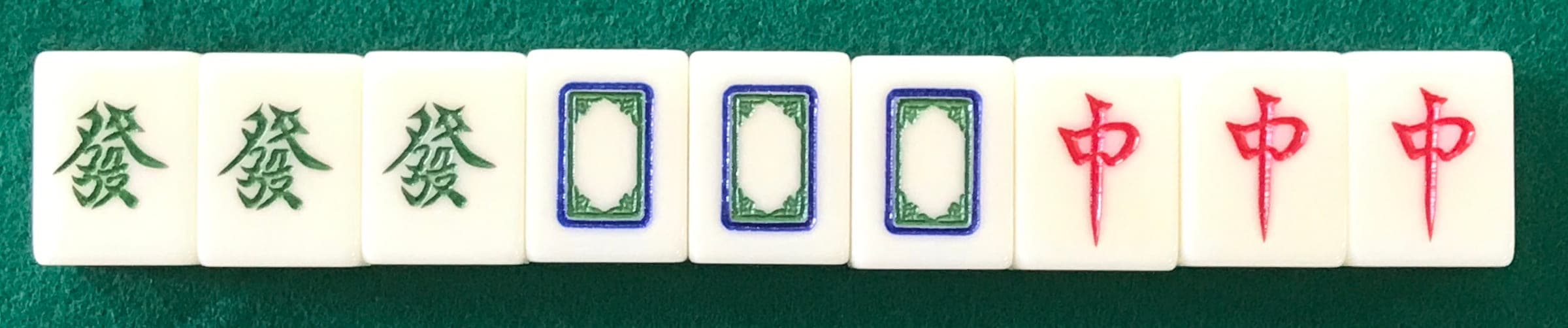
A Pong of each dragon is worth 1 Double.

A Pong of each dragon — 1 Double apiece, and all three together is Da San Yuan.

Doubles & points from animals

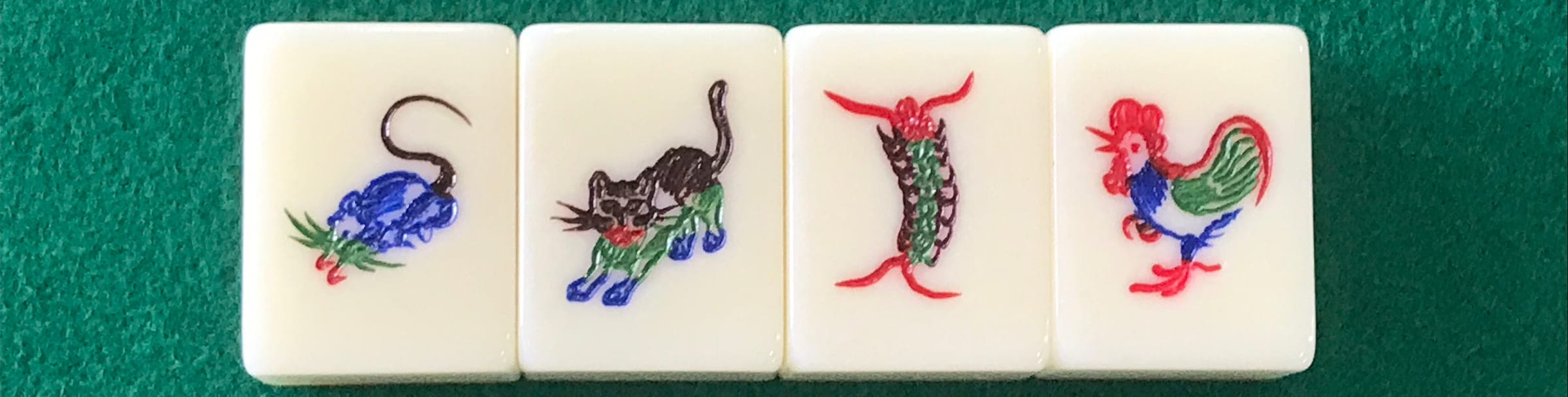
Each animal is worth 1 Double. Collecting a matching pair (Um Yao or Yao) (i.e. cat-rat, chicken-centipede) entitles the person to extra points, equal to the amount for Um Kong or Kong, depending on whether the pair was acquired at the breaking of the wall or later in the game. Collecting all 4 animals entitles the person to extra points (equal to an Um Kong or Kong) as well as an Extra Double (i.e. all 4 animals are worth 5 Doubles).

The four animal tiles: rat, cat, centipede and rooster
The two matching pairs: rat-cat and centipede-chicken.

Doubles & points from flowers

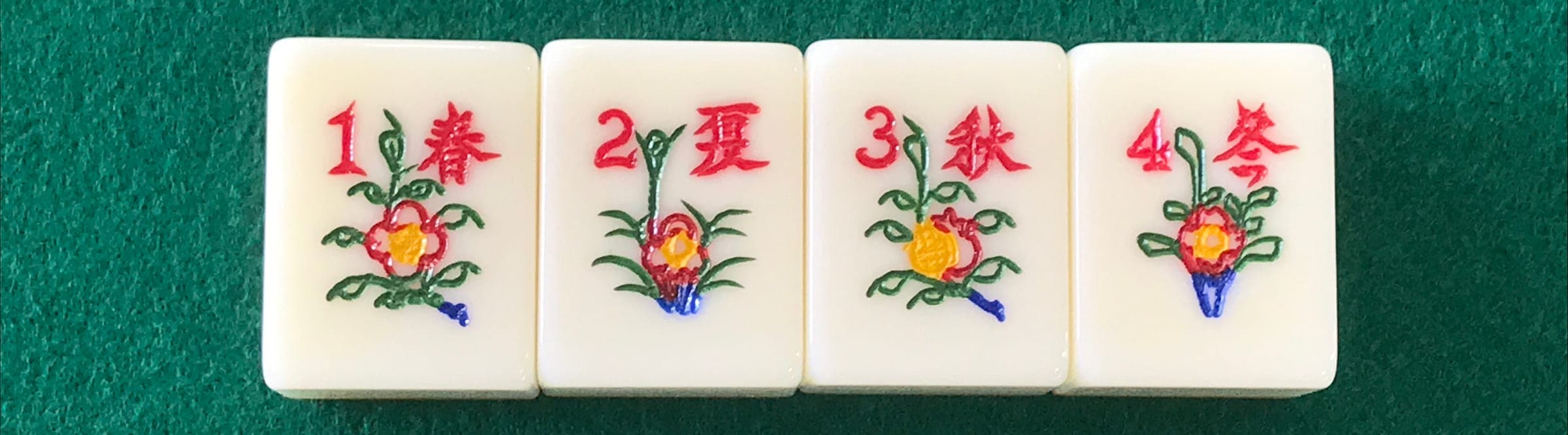
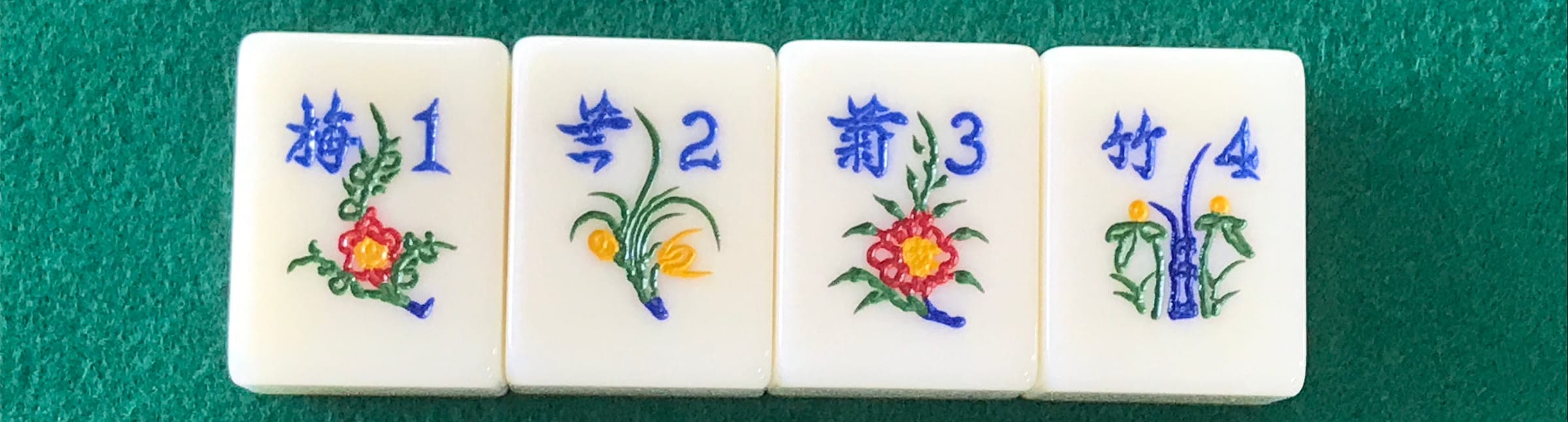
The flowers correspond to the player’s wind for that hand (this changes from hand to hand, with reference to the dealer). East is number 1, South is number 2, West is number 3 and North is number 4. A flower that corresponds to a player’s number is worth 1 Double, other flowers are worth no Doubles.

A set of 4 flowers of the same colour is worth extra points, equal to the amount for Um Kong or Kong, depending on whether the pair was acquired at the breaking of the wall or later in the game. The set may also be worth an extra Double.

A pair of your own flowers (Um Yao or Yao) is worth extra points, equal to the amount for Um Kong or Kong, depending on whether the pair was acquired at the breaking of the wall or later in the game.

A variation exists where having a pair of someone else’s flowers means that the player whose pair you have has to pay you the amount for Um Kong or Kong, depending on whether the pair was acquired at the breaking of the wall or later in the game.

The four red flower tiles, numbered 1 to 4
Red flowers — 1 East, 2 South, 3 West, 4 North.
The four blue flower tiles, numbered 1 to 4
Blue flowers, numbered to the same winds.

Standard hands

It is important to remember that patterns can be combined (e.g. a Qing Yi Se Chao Ping Hu is worth 5 Doubles) and the total number of Doubles should include Doubles from Flowers, Animals, Winds & Dragons.

Sequence Hand

Ping Hu4 doubles

A Ping Hu or Chao Ping Hu hand has 4 sets of Chi and a pair. The pair cannot be anything that will give a Double if Ponged (i.e. no dragon pairs, no pairs of prevailing or player’s own wind). The hand must ultimately be calling for at least two tiles. This means if a player is waiting for only 1 tile, the player can only game by Zhi Mo.

A Ping Hu is a hand that does not have any flowers or animals; it does not have to be concealed (note that only a maximum of three melds can be exposed, otherwise it is obvious the player cannot be calling for at least two tiles) & is worth 4 Doubles.

Often, an extra Double is given if the Ping Hu or Chao Ping Hu is concealed.

Example

Four sequences and a non-scoring pair.
Sequence Hand completed

Sequence Hand with flowers

Chao Ping Hu1 double

A Chao Ping Hu hand has flowers or animals, does not have to be concealed (note that only a maximum of three melds can be exposed, otherwise it is obvious the player cannot be calling for at least two tiles) and is worth 1 Double.

Often, an extra Double is given if the Ping Hu or Chao Ping Hu is concealed.

Example

The same shape as Ping Hu, with a flower on the table — that alone drops it from 4 Doubles to 1.

Triplets Hand

Pong Pong Hu2 doubles

Also known as Dui Dui Hu

A Pong Pong hand has 4 sets of Pong/Kong and a pair. The hand does not have to be concealed & is worth 2 Doubles. Additional doubles can be added for Dragons and/or prevailing or player’s winds.

Example

Four triplets and a pair.
Triplets Hand completed

Full Flush

Qing Yi Se4 doubles

The hand can have 4 sets of either Chi/Pong/Kong and a pair. However, all tiles in the hand must be of one suit. The hand does not have to be concealed & is worth 4 Doubles. Additional doubles can be added for Ping Hu or Chao Ping Hu or Pong Pong hands.

Example

One suit throughout — sets may be Chi, Pong or Kong.
Full Flush Hand completed

Half Flush

Ban Se2 doubles

Also known as Hun Yi Se

This hand consists of 4 sets of either Chi/Pong/Kong and a pair. The tiles are a mixture of Winds/Dragons and tiles of one suit. The hand does not have to be concealed & is worth 2 Doubles. Additional doubles can be added for Dragons and/or prevailing or player’s winds.

Example

A single suit plus honours.
Half Flush Hand completed

Special hands

It is important to decide before the game which/how Special Hands will be played.

Three Big Scholars

Da San YuanLimit

This hand consists of a Pong of Red, Green & White Dragons. The hand does not have to be concealed & is worth limit. Depending on the agreements made, the hand might not have to be complete.

Example

The three dragon Pongs that define the hand

Three Lesser Scholars

Xiao San Yuan3 doubles

This hand consists of two Pongs & a pair of Red, Green & White Dragons. The hand does not have to be concealed & is worth 3 doubles. The hand must be complete (i.e. have another two pongs/kongs or chis).

Example

Four Great Happiness

Da Si XiLimit

This hand consists of a Pong of East/Dong, South/Nan, West/Xi & North/Bei. The hand does not have to be concealed & is worth limit. Depending on the agreements made, the hand might not have to be complete.

Example

The four wind Pongs that define the hand

Four Lesser Happiness

Xiao Si Xi4 doubles

This hand consists of three Pongs & a pair of East/Dong, South/Nan, West/Xi & North/Bei. The hand does not have to be concealed & is worth 4 doubles. The hand must be complete (i.e. have another pong/kong or chi).

Example

Pure Terminals

Yao JiuLimit

Also known as One-Nine, Yi Jiu

This hand has 4 Pongs of only 1s or 9s of any suit plus a pair of 1s or 9s. The hand does not have to be concealed & is worth limit.

Example

Pure Terminals Hand completed

13 Unique Wonders

Shi San YaoLimitConcealed

Also known as 13 Orphans

This hand has one each of the following tiles, with any of them paired: East/Dong, South/Nan, West/Xi & North/Bei, Red Dragon, Green Dragon, White Dragon, 1 Character, 9 Character, 1 Bamboo, 9 Bamboo, 1 Marble & 9 Marble. The hand must be concealed & is worth limit.

This hand may rob an Um Kong or supersede other winning claims (e.g. in the case where South discards nine bamboo which West can win on but North is calling 13 Orphans, North wins in place of West).

Example

The thirteen tiles, waiting to pair any one of them.
13 Unique Wonders / 13 Orphans Hand waiting to game

Nine Gates

Jiu Lian Bao DengLimitConcealed

Also known as Yi Tiao Long

This hand, when complete, has three 1s, three 9s, a sequence of 2 to 8 (7 tiles) of any one suit, with any additional tile from the suit. The hand must be concealed & is worth limit. Such a hand is potentially calling for all 9 tiles in that suit.

Example

Thirteen tiles of one suit, calling for any of the nine.
Nine Gates Hand waiting to game

18 Arhats

Shi Ba Luo HanLimit

Also known as 4 Kongs

This hand has 4 sets of Kong and a pair. The hand does not have to be concealed & is worth limit.

Example

Four Kongs and a pair.

Jade Hand

Lu Yi SeLimit

This hand has 4 sets of either Chi/Pong/Kong and a pair of only green tiles (i.e. 2, 3, 4, 6, 8 Bamboo and Green Dragon). The hand does not have to be concealed & is worth limit.

Example

Jade Hand completed
Jade Hand completed

All Honours

Zi Yi SeLimit

This hand has 4 Pongs and a pair of only honour tiles (i.e. East/Dong, South/Nan, West/Xi, North/Bei, Green Dragon, Red Dragon or White Dragon). The hand does not have to be concealed & is worth limit.

Example

Concealed Triplets

Dui Dui HuLimitConcealed

This occurs when a player Hu with 4 concealed sets of Pong and a pair in his/her hand. The hand must be concealed & is worth limit. The Hu is usually by Zhi Mo; a Hu on a discard is only permissible when forming the pair.

Example

All The Flowers

Cai Hua ZeiLimit

Also known as Flower Thief

This hand basically ends up with all the flowers. This can occur in 2 ways:

First, no one else has any flowers and player A draws all 7 in the course of the hand. When the 8th is exposed/drawn (by any player), player A will win. Anyone drawing the 8th flower will be Bao.

In such a scenario, player A should reserve the right to check everyone’s tiles at the end of the hand in the event of the draw or in the event someone else Hu. This is to prevent the other players from not exposing the flower if it had been drawn in the course of the hand.

If upon inspection a player is found to have the 8th flower concealed in his/her tiles, the player is considered to be Bao and compensates player A accordingly.

If a reservation is made but a player still scatters their tiles, that player is considered to be Bao and compensates player A accordingly.

Second, one of the other players has a flower but player A draws the remaining 7 flowers. Player A then ‘steals’ the 8th flower in order to win. There is no Bao for this.

The contents of the winner’s hand are inconsequential but should not be revealed. This hand is worth limit. In the event the winner exposes his hand (which is not complete), this may be considered a Zha Hu.

Example

All eight flowers — both the red and the blue set.

Heaven Game

Tian HuLimitConcealed

This occurs when the dealer Hu with the original (or after replenishing flowers) 14 tiles he/she drew from breaking the wall. The hand is concealed & is worth limit. In most cases, no minimum Double is needed but it is best to confirm beforehand.

Earth Game

Di HuLimitConcealed

This occurs when a player wins on the first discard dealer makes. The hand is concealed & is worth limit. In most cases, no minimum Double is needed but it is best to confirm beforehand.

Another variation is when someone other than the dealer Hu within the first round of discards. Note that if North Pongs the first discard East makes, then the first round of discard is considered to be over. Similarly, if West Pongs, then South cannot Di Hu but North still can. This is sometimes referred to as Human Game (Ren Hu).

Unusual hands

It is important to decide before the game which/how Unusual Hands will be played.

Blue Hand

Limit

This hand has 4 sets of Pong and a pair of only blue tiles (i.e. East/Dong, South/Nan, West/Xi, North/Bei, 8 Marbles and White Dragon). The hand does not have to be concealed & is worth limit.

Example

Blue Hand completed
Blue Hand completed

Super Dealer

Limit

If a dealer manages to retain dealership (diao zheng) 8 times in a row, from the 9th hand where he/she is dealer, if he/she manages to Hu, it is counted as a limit hand. He/she does not have to have a minimum number of Doubles to Hu from the ninth hand onwards.

Seven Pairs

Ci Dui Zi4 doublesConcealed

This hand consists of 7 pairs. The hand can have 2 similar pairs (i.e. an Um Kong of 4 tiles counts as 2 pairs). The hand must be concealed & is worth 4 Doubles.

Example

Seven Pairs Hand completed

Windy Chow

4 doublesConcealed

A Windy Chow hand consists of 3 Chis, one in each suit, one tile of East/dong, South/nan, West/xi & North/bei, with any of these winds paired. The hand must be concealed & is worth 4 doubles.

(note that you can also call any part of a chi if you have a pair of winds in hand)

Example

A Windy Chow Hand waiting to game

Founding of Singapore

LimitConcealed

The Founding of Singapore hand consists of 1, 8, 1, 9 in the bamboo suit (to represent traditions), 1, 9, 6, 5 in the character suit (symbolising modernity), a Pong of East/dong and a Pong of West/xi (representing Singapore’s place in the confluence of Eastern & Western cultures). The hand must be concealed & is worth limit.

Example

1819 in bamboo, 1965 in characters, East and West Ponged.
Founding of Singapore Hand completed

Honoured Knitting

4 doublesConcealed

Honoured knitting refers to a hand that has any 14 of the following 16 tiles - Winds (East/dong, South/nan, West/xi, North/bei), Dragons (White, Green, Red) and 1-4-7 of Suit A, 2-5-8 of Suit B, 3-6-9 of Suit C. This hand does not have a pair. The hand must be concealed & is worth 4 doubles.

Example

Fourteen of the sixteen eligible tiles — no pair.

Pure Knitting

LimitConcealed

Pure knitting refers to a hand with 4 chis and a pair. The first tile in each chi must be from Suit A, the middle tile from Suit B and the last tile from Suit C. The pair must be from Suits A & C. The hand must be concealed & is worth limit.

Example

Each run takes one tile from each suit, in a fixed order.

Lincoln Hand

1 doubleConcealed

A Lincoln Hand does not have any Dragons (White, Green, Red), only Winds (East/dong, South/nan, West/xi, North/bei) that do not give the player a double if Pong-ed, and no more than four tiles in any suit. The tiles in any suit cannot form a chi or pong, or be adjacent to another (e.g. 1-2, 8-9, 4-5 in the same suit is not allowed). The hand must have a pair of any suitable tiles. The hand must be concealed & is worth 1 double.

Example

Nothing adjacent, nothing tripled, no dragons.

An extra double

Three situations that add a Double to whatever the hand is already worth.

Picking the Pearl (Hai Di Lao Yue)

This occurs when a player Hu on drawing the one of marbles 1 Marble when there are only 5 or fewer tiles left in the wall.

Variations include:

  1. Hu on any tile drawn from the wall when there are only 5 or fewer tiles left, or
  2. Hu on the last tile drawn from the wall.

Robbing a Kong (Qiang Kang)

This occurs when a player Hu on a tile that another player wishes to use to Kong an exposed Pong. If Player B has Ponged and wishes to Kong with the last tile, Player A can Qiang Kang. In this case, Player B is considered to have discarded the winning tile. Player B is also not compensated for the attempted Kong.

Note that it is not possible to rob an Um Kong. The only gaming hand that can steal an Um Kong is the 13 Unique Wonders / 13 Orphans hand (Shi San Yao).

Flower up (Hua/Kong Sang)

This occurs when a person Hu on a tile drawn from the flower pile (after replenishing a flower/animal or topping up a kong).

Variations include:

  1. consecutive Hua/Kong Sang (i.e. if a person draws a flower/animal or melds a Kong, draws another flower/animal or melds another Kong from the flower pile and then Hu, then the Hua/Kong Sang is worth the limit),
  2. cumulative Hua/Kong Sang (e.g. if a person draws a flower/animal or melds a Kong, draws another flower/animal or melds a Kong from the flower pile, draws a third flower/animal or melds a Kong and then Hu, then the Hua/Kong Sang is worth 3 Doubles), or
  3. Zha Hu instead of Hu if a player wins after replenishing 3 consecutive flowers/animals/Kongs.

Faults and penalties

What happens when a hand is declared wrongly, or a discard hands someone the game.

Zha Hu

This occurs when someone declares Hu but his/her hand is found to be either (i) incomplete, (ii) lacking the requisite number of tiles, (iii) does not satisfy the agreements about hand patterns made at the start of the game or (iv) does not satisfy the agreed minimum number of Doubles. In such a situation, the offender loses the agreed Zhi Mo limit points to every other player.

Xiao Xiang Gong

This occurs when a player has too few tiles (i.e. fewer than 13, 10, 7, 4, 1 concealed). Such a player is permitted to Kong but cannot Hu. If he/she declares Hu, it is considered as Zha Hu.

Da Xiang Gong

This occurs when a player has too many tiles (i.e. more than 13, 10, 7, 4, 1 concealed). Such a player is not permitted to Kong or Hu; if he/she declares Kong or Hu, it will be considered as Zha Hu.

Also, he/she will Bao if he/she discards the winning tile for any player.

Bao

When A is said to be Bao by B in the course of a hand, it means that A will bear everyone’s losses in the event that B wins via (i) A throwing the winning tile or (ii) B Zhi Mo the winning tile. It is usually polite to alert the others to a Bao situation.

There are various ways a person can be ‘Bao’ in the course of the game:

  • B has exposed Pongs of 2 of the 3 Dragons. A throws the 3rd Dragon which allows B to either Pong or Hu (depending on agreed rules).
  • B has exposed Pongs of 3 of the 4 Winds. A throws the 4th Wind which allows B to either Pong or Hu (depending on agreed rules).
  • B has exposed Pongs of all honours. A throws an honour tile for B to Pong, Kong or Hu.
  • B has exposed 3 Pongs of 1s and 9s. A throws a 1 or 9 which allows B to either Pong or Hu.
  • B has 1 (occasionally 2) Double(s) less than the agreed limit exposed. A throws a tile that gives B the limit-going Double(s), which B claims via a Pong or Hu.
  • B has 9 exposed tiles in one suit. A throws a tile of that suit for B to Chi, Pong, Kong or Hu.
  • B has 9 exposed tiles for Jade Hand or Blue Hand. A throws a tile of that hand for B to Chi, Pong, Kong or Hu.
  • B has 7 flowers on the table. A gets the last flower.

There are some variations of Bao. First, Bao can occur even when a player has the maximum number of doubles exposed. Second, the Bao can be rolled over, i.e. someone can take over being Bao. Third, if there is a Bao, only the person who Bao, player A, and the person who threw the winning tile, player C, have to pay the winner, player B (i.e. they each foot half the amount of points that the last player D would have lost on top of whatever points they lose).

Bao Qing

There are 8 (or 5, in some versions) tiles left to draw in the wall. A makes a fresh discard (i.e. a tile not in the discard pile) that results in B winning. A bears the cost of the Hu for all other players.

Bao Kang

There are 5 tiles left to draw in the wall. A makes a fresh discard (i.e. a tile not in the discard pile) that results in B making a Kong. A bears the cost of the Kong for all other players.

Aiming a claim

A player cannot claim the second discard of a similar tile to make a Pong or Hu within the same round of discards (i.e. before having a chance to draw). For example, North has 2 Red Dragons, East discards Red Dragon, South immediately follows by discarding Red Dragon, North then makes a Pong, this is NOT allowed.

Discarding a similar tile

A player cannot make an exposed Pong and then discard the same tile (i.e. forgoing a kong) immediately after claiming the discard.

Also, a player cannot make an exposed Chi by claiming a discard and then discarding a tile that could have been a part of the recently exposed sequence (e.g. a player claims the discard of 4 Bamboo to make an exposed Chi of 4, 5, 6 Bamboo, he/she cannot immediately discard 4 or 7 Bamboo).