Before the first tile
Setting up the game
What is in the set, who sits where, what to agree on, and how stakes are counted.
By Gerald Ajam Updated
The tiles
Singapore mahjong is played with 148 tiles: 108 suited tiles, 28 winds and dragons, 8 flowers and 4 animals. Most sets outside Singapore and Malaysia have no animals.
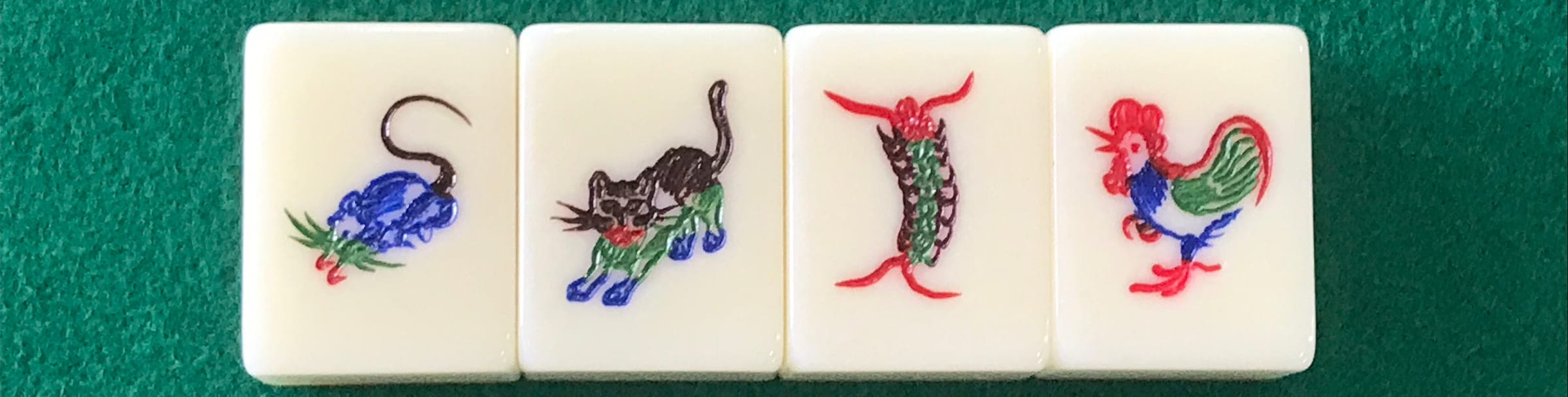
Animals
1 set of 4rat-cat pair & centipede-chicken pair
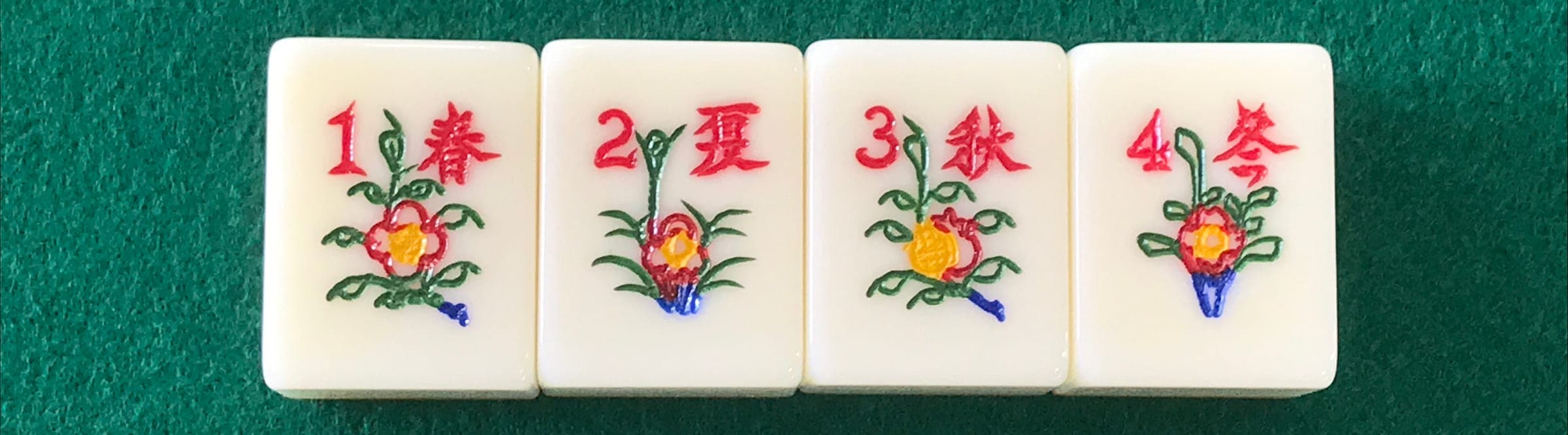
Seasons
1 set of 4春 1 Spring/Chun, 夏 2 Summer/Xia, 秋 3 Autumn/Qiu, 冬 4 Winter/Dong. Often printed in red, but the colour varies by set — the characters and the numbers do not.
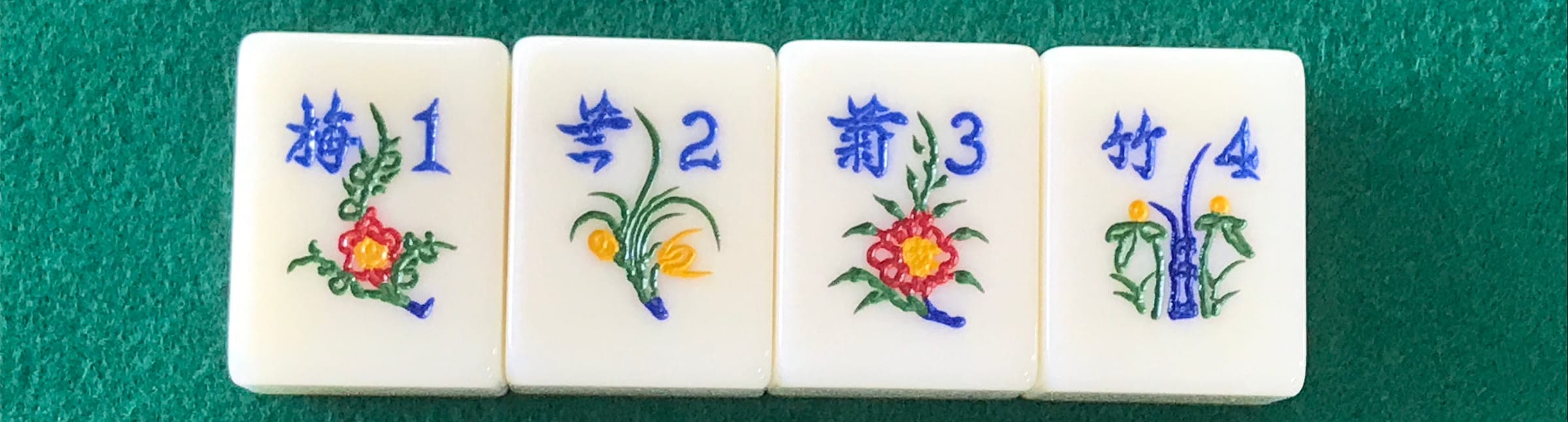
Plants — the four gentlemen
1 set of 4梅 1 Plum/Mei, 蘭 2 Orchid/Lan, 菊 3 Chrysanthemum/Ju, 竹 4 Bamboo/Zhu. Often printed in blue, but the colour varies by set — go by the character and the number.
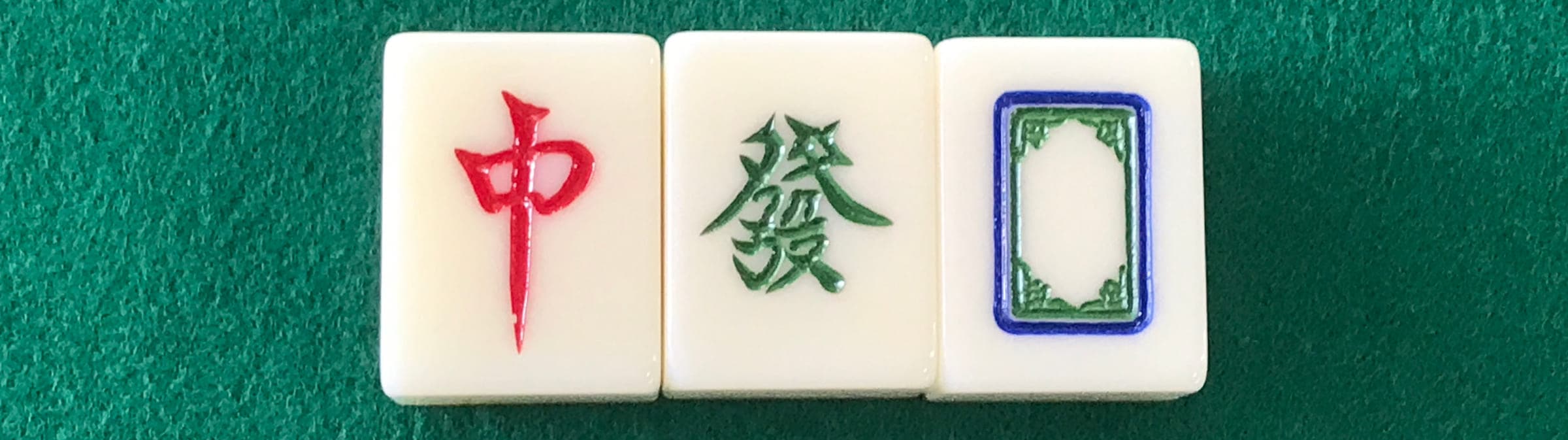
Dragons
4 sets of 3Red Dragon/Hong Zhong, Green Dragon/Fa Cai, White Dragon/Bai Ban
Winds
4 sets of 4East/Dong, South/Nan, West/Xi, North/Bei
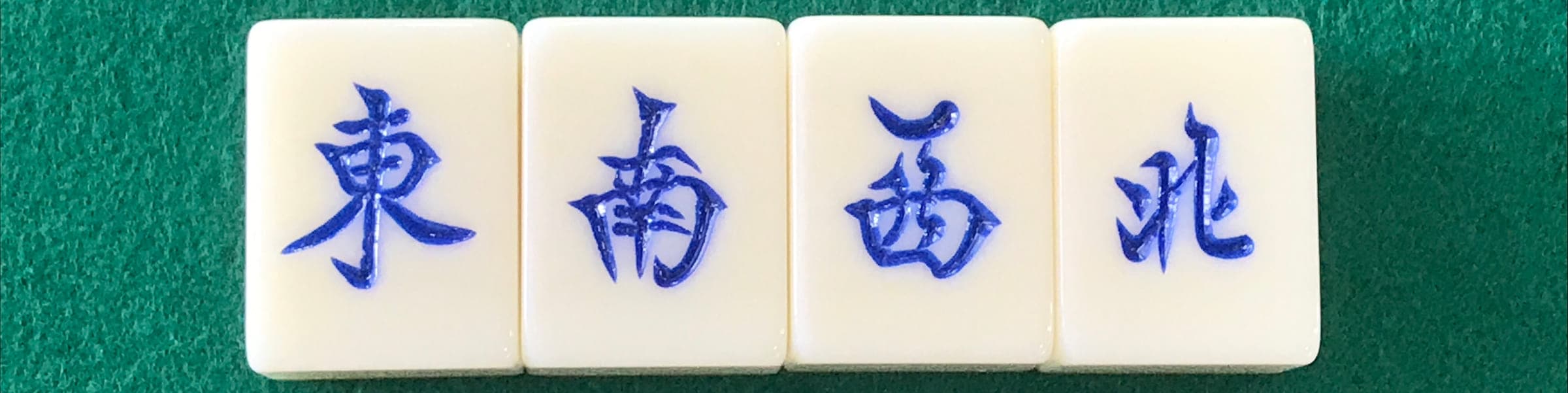
Characters
4 sets of 9numbered 1 to 9, called wan zhi

Bamboos
4 sets of 9numbered 1 to 9, called suo zhi

Marbles
4 sets of 9numbered 1 to 9, called tong zhi

Seating order
One common way to decide seats: deal out one of each wind tile, and whoever draws East picks a seat. Everyone else sits by the wind they drew.
There are several ways of determining who sits where at the start of the game. One way is to slug it out or to come to common consensus. But if you want to be ‘professional’, I suggest the following:
All 4 players randomly sit at the table. One person gathers 1 of each wind, shuffles them and stacks them into a column. Another person (usually the host or homeowner) rolls 2 dice. There are then 2 ways to deal out the stacked tiles:
(a) Count off the players
The person who stacked the column counts off the number rolled, counting him/herself as one and continuing in a counter-clockwise direction. The person whose number corresponds with the number rolled gets the topmost tile, the person to his/her right gets the next and so on. The person who gets the dong gets to pick where he/she sits and the others sit themselves according to the tile they have drawn, in relation to the dong’s choice of seat.
(b) Cut the stack
The person who stacked the column counts off the number rolled from the stack, counting the topmost tile as one and moving downwards, continuing at the top when he/she reaches the fourth (bottom) tile. He/she counts off the number rolled and cuts the stack at this position, moving any tiles held to the bottom of the pile (see example below). He/she then takes the topmost tile, the person on his/her right gets the next and so on. The person who gets the dong gets to pick where he/she sits and the others sit themselves according to the tile they have drawn, in relation to the dong’s choice of seat.
Initial random stack
- 1
- 2
- 3cut here
- 4
Count 7 from the top, wrapping back to the top after the fourth tile — that is position 3.
Ready for dealing
- West (xi)The counter
- South (nan)To their right
- North (bei)Opposite
- East (dong)To their left
The player to their left draws dong and so picks their seat; the others place themselves around that choice according to the tile they drew.
Re-seating between rounds
All seats are re-assigned at the end of a round of mahjong. To do so, there are two options:
- The Absolute East forms the column stacking as described above. The Absolute North rolls the dice. Then follow steps (a) or (b) as above.
- The biggest winner forms the column stacking as described above. The biggest loser rolls the dice. Then follow steps (a) or (b) as above.
This process should lead to a change of seats for at least 2 players. If not, perform the column stacking process again until at least 2 players are seated in different positions.
How stakes are referred to
How much a hand is worth is determined by the number of Doubles it contains, up to the agreed limit.
Stakes are discussed in terms of how many points a hand with 1 Double is worth – this usually involves a pair of numbers; one for Hu by discard and one for Zhi Mo (which is usually twice the amount agreed for Hu by discard).
For example, if 5 is the agreed limit and it is agreed that 1 Double is worth 10–20, the table below shows how many points each person loses or gains:
Settle a hand
Tap a number of doubles
Win — Zhi Mo
+240
You drew the winning tile yourself. All three players pay.
Win — by discard
+160
Someone discarded the tile you needed.
Lose — threw it / Zhi Mo
−80
You discarded the winning tile, or the winner won by Zhi Mo.
Lose — non-offender
−40
You lost, but you were not the one who discarded.
Kong / Yao is settled separately, usually at 2–2.5× one Double: 20 for an exposed Kong, 40 for an Um Kong.
Full table
| Doubles | Zhi Mowin · ×6 | by discardwin · ×4 | threw it / Zhi Molose · ×2 | non-offenderlose · ×1 |
|---|---|---|---|---|
| 1 | +60 | +40 | −20 | −10 |
| 2 | +120 | +80 | −40 | −20 |
| 3 | +240 | +160 | −80 | −40 |
| 4 | +480 | +320 | −160 | −80 |
| 5 limit | +960 | +640 | −320 | −160 |
Each row doubles the one above it. The columns are fixed multiples of one another — 6 : 4 : 2 : 1 — so a Zhi Mo always collects one and a half times what a win by discard collects.
5 doubles is usually considered the maximum limit.
Players may agree to a fixed stake bonus (e.g. 100 points) for each double above 5. Players can also agree to additional stake bonuses for Zhi Mo or other special situations (e.g. Zhi Mo Dan Diao/Ka Long).
Occasionally, the stakes discussed might begin at 0 Doubles, so it is important to clarify whether the count starts at 0 or 1 Double. Also, extra points might be given for Zhi Mo.
Similarly, some number of points is decided for Kong/Yao (the amount is usually 2-2.5 times the amount for 1 Double) e.g. 20 for Kong/Yao, 40 for Um Kong/Yao.
Minimum doubles
Most tables need a hand to be worth at least 1 Double before it can win. Some agree a higher minimum.
Usually, there is a 1 Double minimum (can be higher). This means that for a player to Hu, his/her hand must consist of at least 1 Double in the form of flowers, animals, winds, dragons or the pattern itself (e.g. Chao Ping Hu). How to acquire Doubles is discussed in the section on scoring the game.
Things to decide first
Before the first hand, agree the stakes, the minimum and the limit, what a draw does to the deal, which special hands count, and whether shooter or auto limit applies. Most disputes later are really disagreements about one of these.
- What are the stakes (in terms of points)? How many points for Kong/Yao?
- How many doubles minimum & what is the limit?
- What happens in the event of a draw? Does the dealer move on or is retained?
- Any extra points for Zhi Mo?
- Extra for concealed Ping Hu or Chao Ping Hu?
- Extra for ka long, dan diao, pong pong?
- What special hands are in play (e.g. 7 pairs, windy chow)? What are the winning conditions for these hands?
- Do you need to complete a Da San Yuan Hand or Si Da Xi Hand? If you do not have to complete the hand, is it a Zha Hu if you expose your other tiles?
- Do shooter rules apply? Under shooter, a Hu by discard is paid for entirely by the player who threw the tile, and the other two pay nothing. An exposed Kong claimed off a discard is settled the same way.
- Does an auto-limit apply, and from how many Doubles? At or above that number the distinction between the player who threw the tile and the two who did not disappears: everyone pays the same amount, the one the thrower alone would have paid, so a Hu by discard settles exactly as a Zhi Mo would.